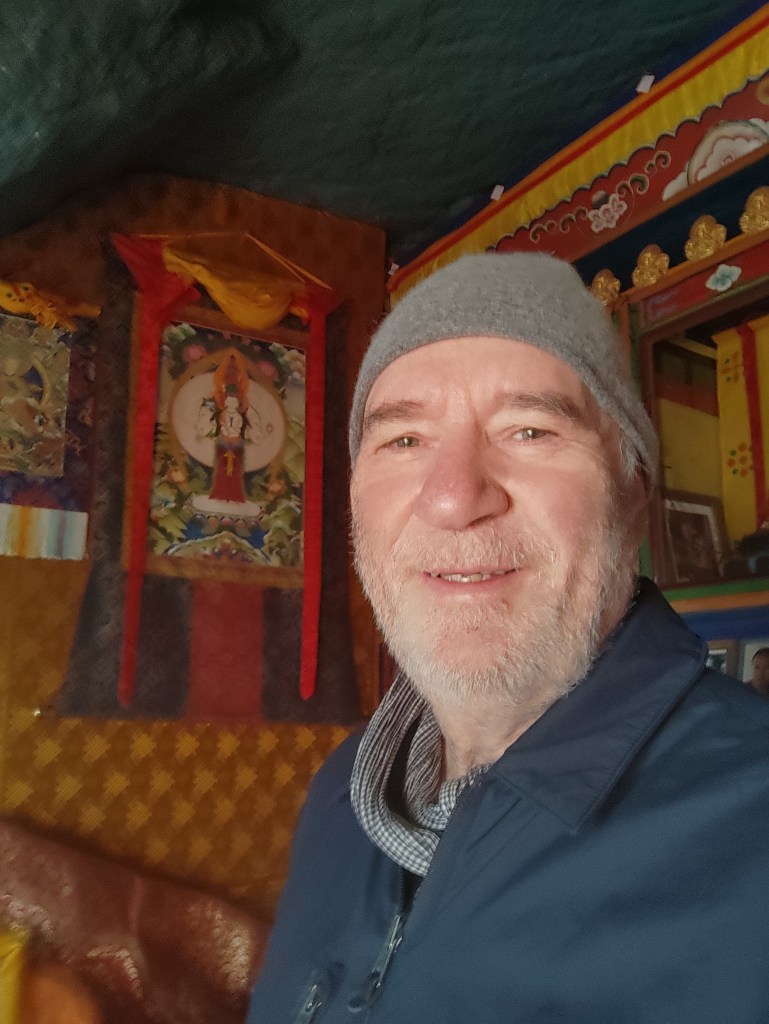
Wanderer Between Worlds
Traveler – Researcher – Development Actor – Writer
Born in Zurich in 1951, I had a strong fascination with distant places and their alien cultures even in my childhood.
At the age of twenty-two, my travels began when I journeyed on the Hippie Trail in crowded trains and rickety buses to Kathmandu, guided by the motto “If I ever get outa here, I am going to Kathmandu” (Bob Seger). After further trips across Asia, I decided to deepen my interest in Tibet, the Himalayas, and India through studies at the University of Zurich, focusing on ethnology, Sanskrit, and religious history. My master’s thesis, titled “Renunciation and Cave Hermitages in Tibetan Buddhism,” was based on a year of research in Ladakh and Nepal. My academic training, various field research projects, and work as a cultural tour guide in the Himalayan region opened access to a complex, wondrous world that has continued to influence me in many ways.
Following my studies, I worked in development cooperation in several Asian countries, accompanied by my family. From 1989 to 1992, we lived in the hills of Palpa, a district in Nepal’s Lumbini Zone, for three years, during which I was involved in an integrated development project. This period was a fortunate coincidence, as my wife Elisabet had already spent a year in Nepal for her master’s thesis in ethnology, and I was familiar with Nepal from previous travels. For our son Jonas, it was a new life experience at the preschool age. Later, I had additional assignments abroad, initially for five years in Bangladesh. By then, our daughter Linda had joined the family. Further assignments in Asia followed in South India, Sumatra, Myanmar, Cambodia, and again in Nepal. I was also responsible for the Swiss Red Cross health program in Tibet for three years.
However, the most significant journeys were inward—exploring one’s own mind and consciousness through meditation. Besides initial teachings from Fred von Allmen and other Western teachers, it was primarily the Burmese scholar and meditation master Aggamahapandita Dr. Rewata Dhamma who profoundly influenced my understanding of the teachings and meditation practice over the years. Courses with Ajahn Sumedho and Ajahn Tiradhammo in the Thai forest tradition also contributed to this period.
Key to the further development of my practice were later stays in meditation monasteries in Myanmar. During my second visit, in 1992, I attended 1992 a three-month retreat with Sayadaw U Pandita Bivamsa, a leading Vipassanā meditation master. Additional retreats in this tradition took place in Myanmar and at a branch monastery in Lumbini, Nepal—the birthplace of Buddha—where the German monk Sayadaw U Vivekananda has served as abbot and meditation teacher for about twenty-five years. Before and after my retirement in 2017, he was a patient and inspiring guide in my practice. A valuable teacher in the same tradition was Sayalay Daw Viranani, an American nun who was ordained in Myanmar and lived at the Chanmyay Myaing Monastery until recently. I am deeply grateful to all these teachers.
This blog, The Pilgrim’s Joy, features a collection of Himalayan pilgrimages rooted in Buddhist and Hindu traditions. After many journeys and extended stays in Asia from 1973 to 2025, these traditions have become my spiritual home. Some of the pilgrimages I undertook decades ago resurface from the mists of the past, while others are more recent.
Occasionally, I recall the song lyrics: “… my memories are fading, like footprints in the melting snow” (John Mayall). Yet, perhaps because of this, I wish to share some memories and insights in my third phase of life with those who are also pilgrims or are interested in the spiritual journey.
Peter Eppler